
Understand the decisions behind every hand
 Available in US
A guide to table layout, dealer play, key rules and the choices that shape a blackjack hand.
How a Blackjack Table Works
Blackjack is a contest between each player and the dealer, not a competition among the people seated around the table. Your aim is to finish with a hand closer to 21 than the dealer’s without going over. The other players may be taking turns at the same table, but their cards do not determine whether your hand beats the dealer’s.
That distinction can be easy to miss when you first approach a blackjack table at a casino. The layout brings several players together around one dealer, creating a shared game in appearance. In practice, each player’s result is assessed separately against the dealer’s hand. A player can lose while someone beside them wins, or the reverse; another player’s success does not take the dealer’s place as your opponent.
What happens at the table
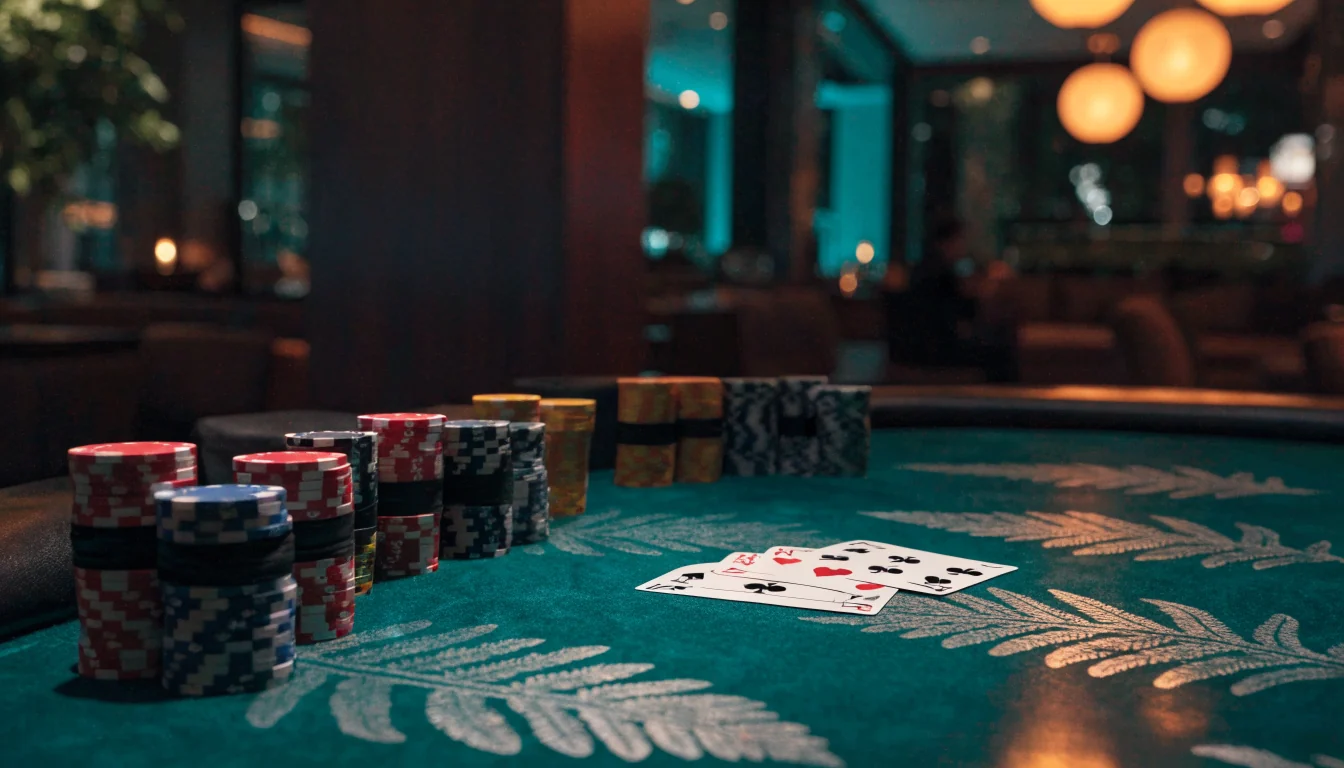
A live casino table has a dealer who manages the game and actual cards used in play. Players take part in turn, making decisions about their own hands while the dealer oversees the round. The table layout is arranged to make the game visible and orderly: players have individual places at the table, while the dealer works from the opposite side. The exact arrangement can differ, but the central idea remains the same—a shared playing area with separate hands facing one dealer.
If you’re looking at blackjack tables in New Zealand in 2026, operator details can help you decide what to check before choosing where to play. Use these verdicts as a concise reference, not as a substitute for checking the terms that matter to you.
-
Neospin
- License
- Tobique Gaming Commission, licence no. 0000064
Neospin lists a Tobique Gaming Commission licence, number 0000064. You can use that identifier as a starting point when checking its licensing details.
-
BitStarz
- License
- Curaçao Gaming Authority, licence no. OGL/2024/165/0185
BitStarz lists a Curaçao Gaming Authority licence, number OGL/2024/165/0185. You can refer to the licence number when verifying the operator’s stated credentials.
-
Ricky Casino
- License
- Tobique Gaming Commission, licence no. 0000002
Ricky Casino lists a Tobique Gaming Commission licence, number 0000002. That licence detail gives you a specific credential to check.
-
Zotabet
- License
- 07017519840
- Payout speed
- 1-3 business days
Zotabet lists the identifier 07017519840 and a payout speed of 1–3 business days. You can take the stated payout window into account when reviewing its payment details.
-
7Bit Casino
- License
- Tobique Gaming Commission, licence no. 0000091
7Bit Casino lists a Tobique Gaming Commission licence, number 0000091. You can use the number to check the licence information it provides.
-
Wintino
- Payout speed
- 1-3 business days
Wintino states a payout speed of 1–3 business days. You can consider that stated timeframe when reviewing its payment information.
-
Lamabet
- Payout speed
- 1-3 business days
Lamabet states a payout speed of 1–3 business days. That gives you a specific payment detail to consider.
-
Play Grand
- License
- Malta Gaming Authority, licence no. MGA/B2C/370/2017
Play Grand lists a Malta Gaming Authority licence, number MGA/B2C/370/2017. You can check the stated licence details as part of your review.
-
N1 Casino
- License
- Malta Gaming Authority, licence no. MGA/B2C/394/2017
N1 Casino lists a Malta Gaming Authority licence, number MGA/B2C/394/2017. The licence number is a concrete detail you can verify.
A blackjack table may have several players at once. That does not mean they form a team, even if they are watching the same dealer and round. Each hand stands on its own. You are not trying to beat the player to your left, and a player’s choice does not alter the basic aim of your hand: finish nearer to 21 than the dealer without exceeding it.
This also explains why the table can feel social without being a head-to-head game between customers. Players may observe one another’s turns, but the dealer is the common opponent. The game’s structure is easier to follow once you keep those two things separate: people share the table, while each person plays their own contest against the dealer.
Live play and online tables
A live blackjack table can mean a physical table in a casino, or an online game streamed from a table where a dealer handles actual cards. The online version reproduces the sight of a dealer and a real table, but you take part through a screen rather than sitting in the room. Live video can make the action feel more like an in-person game; it does not change the fact that your hand is being judged against the dealer’s.
Streaming is not instantaneous. A delay can arise between what happens at the table and what appears on your screen, and live-dealer games may require higher bets than other online formats. Those are practical differences to bear in mind when comparing an online live table with a physical casino table. They do not turn the other players into opponents or change the basic objective of blackjack.

An online casino table can also present the game through a digital interface rather than a live video feed. The table shown on screen is then a representation of the game, not a physical table with players gathered around it. Whether you are looking at a dealer on camera or a computer-rendered table, the key question is still whose hand you are playing against: in blackjack, it is the dealer’s.
Reading the table as a player
The table’s design helps organise a round, but it is not a scoreboard showing which customer is ahead of the others. Each player’s position corresponds to that player’s hand. The dealer’s hand is the point of comparison for everyone at the table. If you are new to the game, this is the most useful feature to understand before focusing on where to sit or how the layout is arranged.
The phrase “21 blackjack” refers to the same central target: get as close to 21 as possible without going over, while finishing ahead of the dealer. It does not mean that every hand must reach 21 to win. The contest is relative to the dealer’s result, so a hand below 21 may still be better than the dealer’s, while a hand that exceeds 21 cannot meet the aim.
A live table can make the round easier to follow because you can see the dealer handle the cards and watch the shared action unfold. It can also feel slower or less immediate online if the stream is delayed. In either setting, the essential relationship stays simple: you play your hand against the dealer, not against the other casino blackjack table players.
Table Rules That Change the Game
Blackjack table rules determine how cards are valued, which decisions are available and how a winning hand is paid. The aim remains to finish closer to 21 than the dealer without going over, but two tables can handle the same hand differently. Before you play, check the rules displayed for that game rather than assuming every casino version follows the same terms.

Card values and a natural blackjack
Number cards count at their face value. Each king, queen and jack is worth 10, while an ace can count as either 1 or 11. The ace’s flexibility means a hand containing one can have two possible totals: an ace and a 6, for instance, can be counted as 7 or 17. A total that can change in this way is called a soft hand; it becomes hard if the ace has to count as 1 to avoid going over 21.
A natural blackjack is an opening hand made up of an ace and a 10-value card. It is distinct from reaching 21 with several cards, and the payout attached to it matters. A specialist review reports that some tables offer a 3:2 payout for a natural blackjack while others use 6:5. Those terms produce different returns on the same hand, so read the payout rule rather than treating “blackjack” as a complete description of what you will receive.
The player’s available actions
The standard decisions are hit, stand, double down and split, though the rules for a particular game determine which options are available in a given situation.
- Hit: Take another card, increasing the hand’s total. If it goes over 21, the hand is bust.
- Stand: Keep the total as it is and take no more cards.
- Double down: Increase the wager on the hand and take a further card under the table’s procedure. This is an option to check in the rules, not an action to assume is available at every point.
- Split: When the opening cards form a pair, separate them into two hands, each played on its own. The table rules set out when splitting is allowed and how split hands are handled.
Some tables also permit surrender: giving up the hand under the conditions set by that game. The detail matters because surrender is not a general escape from a difficult hand; its availability and timing are rule-specific. If you are looking for a table with no double down, check the listed actions directly. A game’s title alone may not tell you whether the option is permitted.
These choices are part of the rules, not a promise that one action will produce a win. A table guide is most useful when it tells you what you are allowed to do and how the game resolves each action. It cannot make different versions interchangeable.
Dealer rules and deck setup
The number of decks used can differ between games. So can the dealer’s obligation on soft 17: one set of rules may require the dealer to take a card, while another may require the dealer to stand. Because an ace can count as 1 or 11, that instruction affects how the dealer plays a hand containing an ace and a 6.
Surrender conditions, deck count and the dealer’s soft-17 rule are among the details that may change from one version to another, according to a specialist review. These are not decorative variations. Together with payout terms, they affect how a hand is resolved and can alter the game’s house edge. The same cards can therefore sit inside games with meaningfully different conditions.
When comparing casino blackjack rules, scan the complete table information: card values, available actions, dealer treatment of soft 17, surrender terms, deck setup and the natural-blackjack payout. If a rule is unclear, pause before placing a wager and find the explanation provided for that table. A small difference in wording can change what happens after the deal; the table felt is not the rulebook.
Online Blackjack Tables and New Zealand’s Licensing Framework
An online blackjack table can be delivered in two different ways. In an RNG game, a random number generator determines the cards through software shuffles. This format generally moves faster because it does not depend on a live dealer handling cards or a video stream reaching your screen. A live-dealer game uses physical cards and shows the game through a stream, bringing the table’s dealing process into view. Streaming can introduce delays, and live-dealer games may require higher bets.
The difference is about how the game is delivered, not who you play against: in either format, blackjack is played against the dealer. A digital interface may make an RNG game feel unlike a casino table, while a live stream gives you a view of actual cards being dealt. Neither format removes the need to understand the rules attached to the particular game. Those details belong to the table, not to the label “RNG” or “live dealer.”

For New Zealand players, the regulatory position has changed during 2026. The Online Casino Gambling Act 2026 took effect on 1 May 2026 and created the country’s first domestic licensing framework for online casino gambling. That does not mean the full regime is already operating: it is expected to be fully in place in 2027.
The transition period runs from 1 May to 1 December 2026. Online casinos that were already serving people in New Zealand before the Act began may continue during that interval, subject to its transitional provisions. This is a temporary arrangement, not a statement that every online casino is licensed in New Zealand. Providers that have not applied for a licence must stop providing online casino gambling in the country by 1 December 2026. If an application is declined, the provider must cease those operations and leave the market.
Before this law, online casinos could not be based in New Zealand under the Gambling Act 2003. Gambling offered from offshore was not licensed or supervised by a New Zealand regulator, and customers using those sites had no domestic government recourse. The new framework changes how licensing is to be handled, but it does not turn the earlier position into a period of local oversight.
Two public bodies have distinct roles. The Department of Internal Affairs is New Zealand’s primary gambling regulator and oversees regulation of the online casino licensing framework. The Gambling Commission handles licensing decisions: it hears and determines casino applications, issues online casino licences and approves changes to licence conditions. In practical terms, the Department oversees the regulatory framework, while the Commission decides applications and certain matters affecting licences.
Department of Internal Affairs
New Zealand’s primary gambling regulator that oversees the regulation of the online casino licensing framework.
Gambling Commission
Handles licensing decisions, determines casino applications, issues licenses, and approves changes to license conditions.
That distinction matters when you read claims about a casino’s status. “Regulated” can refer to oversight of the framework, while a licence is a specific authorisation granted through the Commission’s process. During the transition, the fact that an existing provider is allowed to continue operating does not by itself establish that it holds a New Zealand online casino licence. The timing and the provider’s position in the transition matter.
The format of a blackjack game and its regulatory status are separate questions. Software shuffles may make an RNG table quicker, while a live stream shows physical cards and may be delayed. Neither feature tells you whether the provider is licensed under New Zealand’s new system. The licensing framework is being phased in, so distinguish permission to continue under transitional provisions from a licence issued under the new regime.
Strategy Starts with the Rules, Not a System
A blackjack table strategy is not a single set of instructions that works everywhere. The game’s variant and table rules affect which decisions make sense and how favourable the game is to the house. A choice that is reasonable under one set of rules may be less attractive under another, so advice detached from the table’s conditions can mislead.
Before relying on a strategy guide, check the rules for the game you are considering. Pay attention to the conditions that distinguish one version from another, including how a dealer handles a soft seventeen, whether surrender is available, the number of decks, and the payout for a natural blackjack. These details are not fine print in the ordinary sense: they shape the decisions a strategy is meant to guide.

A basic strategy guide is best treated as a reference built for a particular variant, not as a universal answer key. If the guide assumes different rules from the table, its recommendations may not fit. That applies to a probability table, too. The chance of a particular outcome depends on the game conditions; a table of probabilities without those conditions may offer a false impression of precision.
The same caution applies to a blackjack pay table. It can show what a game pays for particular outcomes, but it does not by itself explain every rule that affects a decision. Read the payout terms alongside the full game rules. A specialist review may report a particular payout arrangement, but that is evidence about the game it reviewed, not proof that every table uses the same terms. A table’s own displayed rules are more relevant to the game in front of you.
If surrender is allowed, a surrender table can help explain when that option may be considered under specified rules. It should not be assumed to apply when surrender is unavailable, or when the table’s other conditions differ from those used to prepare the reference. Treat charts as conditional guidance: first identify the game they describe, then decide whether it matches the table.
A private blackjack table does not, by itself, make a strategy more effective. Privacy may describe the setting or who is present, but the game’s rules remain the important factor for decision-making. Nor does a system become reliable simply because it is easy to follow. Betting progressions and other systems cannot guarantee a win; they do not remove the uncertainty in the game or change the rules.
Card counting is a separate subject from following a strategy chart. In New Zealand, using mental calculation alone to count cards is not illegal. That narrow legal point is not a promise that counting will produce an advantage, and it should not be confused with software or other tools. It is also not a claim that card counting works in every format: online games using automatic software shuffles are not a setting where a player can rely on tracking a continuing sequence of physical cards.
Keep the purpose of strategy in proportion. It can help you make choices that fit a particular version of blackjack; it cannot turn uncertain results into certain ones. Set a budget before playing and do not chase losses. If a game is offered with a promotion, read the terms on a trustworthy site before wagering: blackjack may count differently toward wagering requirements, and maximum-bet rules can apply while those requirements are in force. A strategy guide cannot override those conditions.
Betting, Chips and Electronic Tables
A bet at a blackjack table is the stake attached to a hand. At a physical table, chips make that stake visible; at an electronic table, the interface records it digitally. Either way, the amount you choose is separate from the decisions you make once cards are being dealt. You can hit, stand, double down or split when the game’s rules allow those actions, but they do not make an unaffordable stake sensible.
Before joining a game, decide what you are prepared to spend and treat that as a firm budget, not a target you need to use up. A run of losses can make raising a bet feel like a way to recover what has gone. It is not a reliable way to do so. Chasing losses can turn a defined entertainment expense into a larger one, while no betting pattern guarantees a win.
Physical chips and digital controls
With chips, the value of your stake is represented by the chips placed for play. At an electronic table, the same idea is handled through on-screen controls rather than physical pieces. The appearance and operation of these controls can differ between games, so take a moment to understand what the interface is showing before confirming a bet. Do not assume that every table uses the same layout or sequence.
The interface is part of the transaction: check the displayed stake before you commit, and make sure it reflects what you intended. If anything is unclear, pause rather than relying on a guess. That is especially useful when moving between a physical table, a digital table game and a live-dealer stream, where the presentation may change even though the basic purpose of the bet does not.
Insurance is another wager that may appear at a blackjack table. For most players, it is better not to treat insurance as a routine choice. It is a separate bet, not protection that makes the main hand safe.
Real-money play and bonus terms
If you are considering a bonus, read its conditions before attaching it to blackjack play. Wagering requirements describe how play may count toward meeting a bonus condition, and blackjack may contribute differently from other games. Maximum-bet rules can also apply while wagering requirements are in effect. Check the terms on the casino’s site before playing with real money; a displayed bonus alone does not tell you how blackjack is treated.
- Read the full bonus conditions before playing
- Check how blackjack contributes toward wagering requirements
- Identify any maximum-bet rules in effect
- Confirm the terms on the casino's site
Keep bonus-related play inside the budget you set, and do not increase your stake simply to try to clear a condition sooner. If the terms are difficult to understand, that is a reason to stop and clarify them, not to assume the most favourable interpretation.
A betting choice is not a prediction of the next hand. Chips and electronic balances make the stake easier to place, but they do not change the uncertainty of the game. Choose an amount you can afford to lose, keep track of your spending, and stop when you reach your limit.
When to Hit or Stand
Hitting means taking another card; standing means keeping the hand as it is and taking no more cards. The choice turns on a basic tension: an extra card may bring your total closer to 21, but it may also take you over it. Standing avoids that immediate risk, while leaving your current total unchanged.

The card values give the choice its shape. Number cards count at face value, face cards count as 10, and an ace can count as either 1 or 11. Because an ace can change value, a hand containing one may have more room for another card than its current total first suggests. The aim is to finish closer to 21 than the dealer without exceeding 21.
There is no single hit-or-stand instruction that fits every hand and every game. The dealer’s visible card, your own total and the table’s rules all matter. A reference chart can help organise decisions, but it should match the game being played; the chart is not a substitute for checking which rules apply. A decision that makes sense under one set of rules may not carry over unchanged to another.
Hitting and standing are not the only available actions. Depending on the table, you may also be able to double down, split a pair or surrender. Those choices have separate conditions and consequences, so the decision is not always simply “take a card or stop.” If another action is available, check what it means before selecting it rather than treating it as an automatic extension of a hit.
A question about the maximum bet on a “$5 blackjack table” cannot be answered from the table’s starting figure alone. The maximum is a separate limit, and the posted table terms are what establish it. Don’t assume a low entry point tells you how high a bet can go.
In an online game, the controls may make the available choices visible, but they do not remove the need to decide. Take a moment to confirm which action you are selecting, especially when the interface presents several options together. The useful habit is not to memorise one instruction for every hand; it is to understand what each choice does, then consider it in the context of that particular game.

Choosing a Seat at the Blackjack Table
At a physical blackjack table, choosing a seat is mainly a question of comfort and how you want to take part. The position you occupy does not give you a better chance of winning: the game is still played against the dealer, and another player’s place around the table does not change your hand. If you are deciding on the best place to sit at a blackjack table, think about what helps you follow the play, rather than looking for a position that promises better results.
A seat with a clear view of the cards and the dealer’s actions may make it easier to keep track of what is happening. You might also prefer a position where you can hear the dealer clearly or feel less crowded. These are practical preferences, not strategic advantages. If a table is already in progress, watch how the game is being run and check whether there is an available place before joining. You do not need to copy the decisions of the person beside you; each player makes choices for their own hand.
Online, “taking a seat” is not a matter of choosing a physical position. With a live-dealer game, the screen shows actual cards being dealt at a casino table, giving the experience a closer resemblance to sitting there in person. The stream can introduce delays, however, and some live games may ask for higher bets than other formats. Those details can matter more to your choice than where a digital seat appears on screen.
An online table using software rather than a live stream has no physical seating arrangement to assess. You can focus on whether the display is easy to follow and whether the pace suits you. The interface may show other players, but their positions on screen are not a guide to a better outcome. In either format, choose a game you can comfortably follow and take time to understand how its interface works before committing to play.
If your concern is whether one chair is luckier, there is no sound basis for treating a particular seat as an advantage. Pick the position or format that lets you see the action clearly and make your own decisions without feeling rushed.
Reading a Blackjack Card Chart
A blackjack chart is a reference for connecting the cards in your hand with the game’s decision points. It does not change what a card is worth. Number cards count at face value, a king, queen or jack counts as ten, and an ace may count as one or eleven. That flexibility is why an ace can make a hand “soft”: its total can be adjusted without immediately going over twenty-one.
When you look at a chart, first identify the hand it describes. A chart may separate hands containing an ace counted as eleven from hands without that flexible value, and may also distinguish a pair. Then locate the dealer’s visible card in the chart’s layout. The point is to find the instruction for that combination, not to treat the chart as a general promise about how a hand will end.
Before relying on a chart, check which version of blackjack it was made for. The number of decks can differ, as can whether the dealer draws on or stands on a soft seventeen. Surrender may be available at one table and absent at another. These details can change which decisions a chart recommends, even though the card values remain the same.
A chart is therefore useful only when its assumptions match the table. If the rules are unclear, ask for them or read the posted game information before using the reference. Avoid filling gaps by assuming that a chart applies to every blackjack game; a neat grid cannot account for rules it was not designed around.
Used carefully, a chart helps you read a decision reference and understand why the same hand may be treated differently under different rules. It is not a record of guaranteed outcomes, and it does not replace checking the game’s terms. Keep the distinction clear: card values are fixed, while the conditions that shape decisions can vary.
What a Blackjack Cheat Sheet Can—and Cannot—Tell You
A blackjack table cheat sheet is most useful as a quick reminder, not a strategy that works independently of the game. It can put card values and the names of available actions in one place, helping you recall the basics while you play. It cannot promise a win or replace checking the rules of the particular table.
The values are straightforward: number cards count at face value, face cards count as ten, and an ace can count as either one or eleven. That flexibility means an ace’s value depends on the hand; a compact reference can remind you of the options without deciding what you should do next.
A cheat sheet can also list the main actions. You can hit to take another card, stand to keep your hand as it is, double down, or split a pair. Which action is available or appropriate can depend on the table’s rules and the cards in front of you. The sheet is a memory aid, not an instruction to make the same move every time.
That is the distinction between a cheat sheet and a card chart. A chart is organised to help you look up a decision for a particular hand and situation. A cheat sheet is a shorter prompt: it gathers key terms and values so you do not have to recall them from memory. Neither format makes different blackjack variants identical.
If you use a printed or on-screen reference, make sure it describes the game you are actually playing. A reminder that leaves out a relevant rule can be less useful than taking a moment to read the table information. Treat the sheet as a starting point for understanding the game, not as evidence that a decision is certain or that a system can guarantee a result.
Blackjack Table Limits and Payout Terms
A table’s posted terms tell you what a hand can cost and what a winning blackjack can return. Check them before joining or placing a bet: the name of a game, or the look of its interface, does not establish its limits or payout rules.
“Table limits” refers to the permitted betting range at that table, including its minimum and maximum bet. Those boundaries can differ between games. Read the displayed limits rather than assuming they match another table, even when both are offered by the same casino. If the terms are unclear, pause and check them before committing money.
Payout wording deserves the same attention. A natural blackjack is a two-card hand that totals 21. A specialist review reports that one table may pay 3:2 on a natural blackjack while another may pay 6:5. These are different payout terms, not interchangeable labels: the ratio determines the return relative to the original bet. Treat the review’s figures as an illustration of variation, not as a promise about any particular table. Confirm the payout shown in the game’s rules.
Other conditions can change too. A specialist review notes variation in deck count, whether the dealer draws on soft 17, surrender availability and blackjack payouts. Soft 17 means a hand worth 17 that includes an ace counted as 11. These details are relevant when comparing tables because the same bet can sit within different rule sets.
Look for the rules or paytable panel before you start. Check the minimum and maximum bet, the payout for a natural blackjack, and any listed conditions that affect when a hand is paid. If a table’s information does not match what you expected, do not rely on another game’s terms. A quick check is more useful than discovering a different payout after the hand has been settled.
Casino Games in New Zealand: Rules and Options
Content created by the «casinoslotguidenz.com» team