
Understand the Choices Behind Each Blackjack Hand
 Available in US
A practical guide to hand totals, dealer play, free practice, table rules and the choices that shape each round.
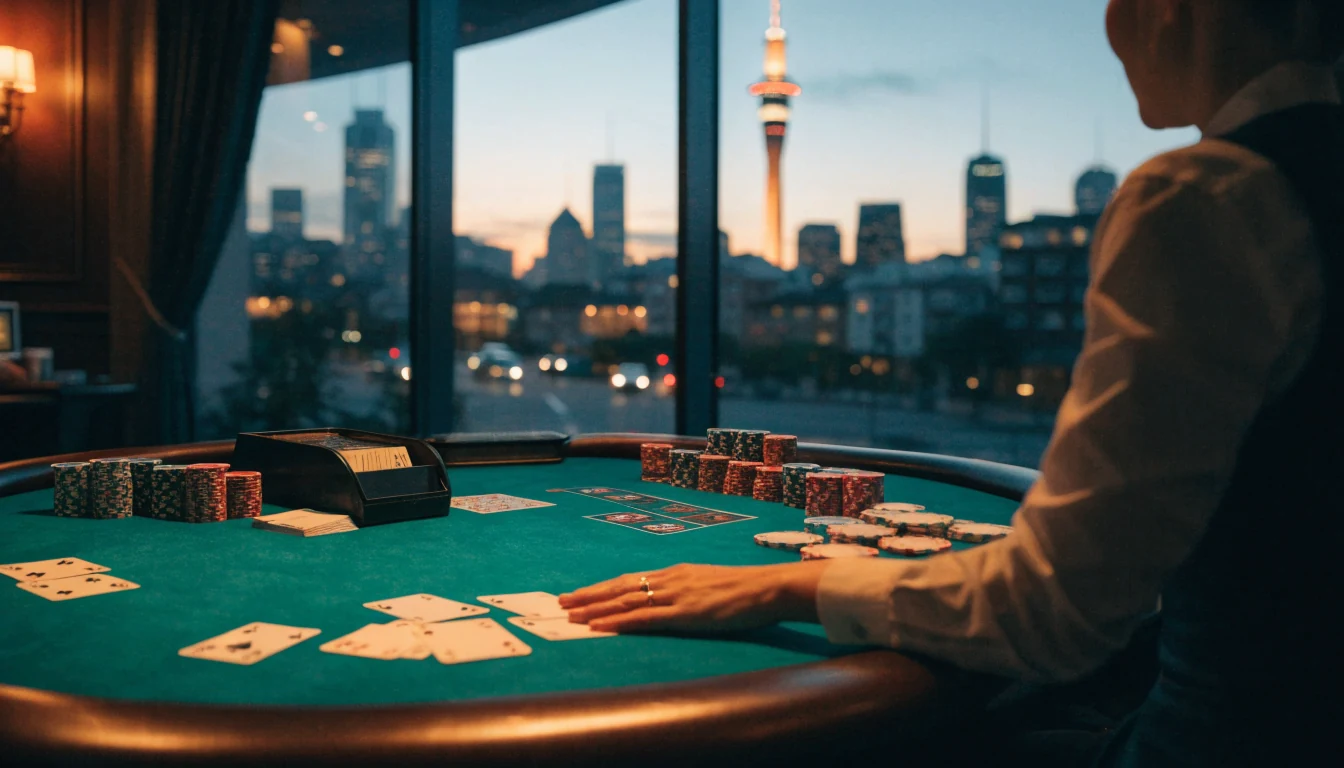
The Deal, the Dealer and Your First Decisions
Blackjack is a contest between your hand and the dealer’s, not a race to reach 21 at any cost. Your aim is to end closer to 21 than the dealer without going over. If your total exceeds 21, you bust and lose the hand, even if the dealer later goes over too. That simple objective guides each decision, but it does not make every hand an obvious one.
A hand begins after players have placed their bets and the cards are dealt. The exact dealing procedure can differ between games, so pay attention to the table instructions rather than assuming every casino handles the opening in precisely the same way. You will have cards that add up to a hand total, and the dealer has a hand of their own. You make decisions about your cards before the dealer completes their play.
Card values are straightforward: number cards count at face value, face cards count as ten, and an ace can count as either one or eleven. The ace is flexible, but it is not a promise of safety. A hand containing an ace counted as eleven is called a soft hand; if another card would take the total over 21, the ace can instead count as one. A hand with no ace, or with an ace that must count as one, is hard. Knowing whether your total is soft or hard helps you understand how much room you have to take another card.
Choosing where to play blackjack online in New Zealand starts with checking the details that matter to you, such as licensing and payout information. Use these brief notes as a reference while deciding where to play.
-
Neospin
- License
- Tobique Gaming Commission, licence no. 0000064
Neospin lists a licence from the Tobique Gaming Commission, number 0000064. You can use that information as one point of reference when considering the casino.
-
BitStarz
- License
- Curaçao Gaming Authority, licence no. OGL/2024/165/0185
BitStarz lists a Curaçao Gaming Authority licence, number OGL/2024/165/0185. Check this licensing detail as part of your research before playing.
-
Ricky Casino
- License
- Tobique Gaming Commission, licence no. 0000002
Ricky Casino lists a Tobique Gaming Commission licence, number 0000002. This gives you a specific licensing detail to consider when assessing the casino.
-
Zotabet
- License
- 07017519840
- Payout speed
- 1-3 business days
Zotabet lists licence number 07017519840 and a payout speed of 1–3 business days. These details give you a licensing reference and an indication of the stated payout timeframe.
-
7Bit Casino
- License
- Tobique Gaming Commission, licence no. 0000091
7Bit Casino lists a Tobique Gaming Commission licence, number 0000091. You can take this stated licence information into account when choosing where to play.
-
Wintino
- Payout speed
- 1-3 business days
Wintino lists a payout speed of 1–3 business days. This gives you a stated timeframe to consider when reviewing its payout information.
-
Lamabet
- Payout speed
- 1-3 business days
Lamabet lists a payout speed of 1–3 business days. You can use this stated timeframe as one factor when considering the casino.
-
Play Grand
- License
- Malta Gaming Authority, licence no. MGA/B2C/370/2017
Play Grand lists a Malta Gaming Authority licence, number MGA/B2C/370/2017. This provides a specific licensing detail for you to check as part of your research.
-
N1 Casino
- License
- Malta Gaming Authority, licence no. MGA/B2C/394/2017
N1 Casino lists a Malta Gaming Authority licence, number MGA/B2C/394/2017. You can consider this stated licence information when deciding whether the casino suits you.
When it is your turn, you can hit to take another card or
Playing Blackjack Online for Free
Free online blackjack lets you open a game without placing a cash stake. Where a free-play mode is available, you can enter a table using virtual credits rather than money. These credits are for the game interface; they are not a balance you can withdraw or convert into cash. Availability and the way a game presents its free mode can differ, so check the screen before you start.
Many free games are software-based. They use a random number generator, or RNG, to determine the shuffle and deal. The cards appear on screen, and you make selections through buttons or other controls. Because the software handles the deal and the table does not wait for a human dealer to act, RNG games allow faster play than live-dealer games. That difference is part of the online format, not a promise that any particular result will follow.
A free RNG game may open in a browser, with no separate download required, if the provider supports browser play. Other versions may require an app or software, and a free mode may not be offered for every title. If you would rather not install anything, check whether the game opens in your browser before proceeding. Avoid assuming that a site’s free-play option covers every table it lists.

Live-dealer blackjack is delivered differently. A real dealer handles actual cards, with a camera stream showing the table and an online interface for your decisions. The experience is closer to a casino table, but it is not automatically free just because it is online. Streaming can delay the pace, and live games may require higher bets. Free access to a live table depends on what is offered; if the interface asks you to stake money, it is not a free game.
The distinction matters when you are choosing a blackjack game online. In a software game, the deal and table actions are managed by the programme, so the screen can move promptly from one decision to the next. In a live game, the stream and the dealer’s actions shape the pace. The two formats may share the same familiar layout, but they do not provide the same kind of online experience.
Some interfaces make free play easy to spot by marking a mode as “demo” or “play for fun”. Others may show a choice between a free mode and a cash table, or display virtual credits once the game opens. Read the labels carefully. A button that launches a game does not, by itself, tell you whether you are playing with virtual credits or risking money. If the terms are unclear, leave the table rather than guessing.
Free mode also should not be confused with a welcome offer or a bonus. An offer may come with conditions, while a no-stake game uses virtual credits and does not require you to wager cash in that game. If you are considering a real-money option later, read the site’s fine print and bonus conditions first. Wagering requirements can treat blackjack differently from other games, and maximum-bet rules may apply while you meet them. Those conditions do not turn a free game into a cash game, but they matter if an offer is involved.
You may see invitations to play blackjack with other people online. A shared digital table can show other participants alongside a dealer or game interface, but the format alone does not mean that you are betting directly against them. Whether a table is software-run or streamed live, check what the game says about its participants and how it is played before joining. The presence of other names or avatars is not enough to establish that the game is player-versus-player.
For a straightforward, no-stake session, look for a clearly labelled free or demo mode and confirm that the game is not asking for a cash wager. Decide between a software deal and a live stream based on the experience you want, not on an assumption that one format is inherently more favourable. An RNG game is generally the quicker of the two formats described here; a live table uses actual cards and may involve streaming delays or higher bets. Those are practical differences, not evidence that either format will produce a particular outcome.

Whether you search for a free online blackjack game or open one from a site’s games menu, the essential check is the same: identify the format and confirm whether the credits are virtual. A game that looks like a casino table can still be software-based, while a streamed table can still have conditions attached to access. Read the labels and terms on the game itself before selecting a mode.
Free Play for Practice, Not Proof of a Winning System
Playing blackjack for free can make the game feel less unfamiliar. You can follow a hand from the opening deal to its result, notice when a decision is required and get used to the pace without putting money at stake. That is a reasonable use of free play: learning the routine and seeing how choices affect the hand in front of you.
It can also be a way to play blackjack for fun, with no expectation that a session must produce a profit. The distinction matters. Free play gives you room to explore, but it does not show that a particular betting approach will work when real money is involved. A run of favourable results in a free game is not evidence that the same pattern will continue later.
Use practice to understand decisions
A practice session is more useful when you pay attention to your choices rather than only to whether the hand wins. For instance, keep track of what happens when you hit, stand, double down or split. Those options affect how a hand develops, but choosing one does not control the cards that follow.
You can also use practice to become more comfortable adding a hand’s value. Number cards count at their face value, court cards count as ten, and an ace can be worth one or eleven. In a free session, there is time to pause and check how an ace affects the total, or to think through a decision without the added pressure of a stake.
This sort of repetition may help you recognise the sequence of decisions more readily. It cannot make a decision certain to succeed. A choice can be sensible in the circumstances and still be followed by an unfavourable result; a lucky result does not, by itself, make the choice sound. Keeping those two things separate is more useful than judging every decision by the last card dealt.
If you play blackjack free for fun, choose a simple aim for the session: follow each hand, notice where you hesitate, or practise making decisions without rushing. That gives the activity a purpose without turning it into a test of whether you have discovered a winning system. There is no need to increase stakes in a free game to make it feel more instructive.
What free play cannot establish
A free game does not reproduce every consequence of wagering real money. Without money at risk, you may feel less pressure, make decisions more casually or play for longer than you would with a real stake. A comfortable practice session therefore cannot tell you exactly how you will react when money is involved.
Nor can a short run of wins or losses prove that a betting pattern has an edge. The results of a limited session are not a reliable forecast of future results. Increasing or changing bets after a win does not turn that past outcome into evidence of a dependable method. No betting system should be treated as a guaranteed way to win.
Free play is not card counting practice that proves an approach will work online, either. In particular, practice results cannot demonstrate that card counting is effective in games that use automatic shuffles. Learning the feel of decisions and predicting future results are different tasks.
If you later choose to wager, set a budget before you begin and do not chase losses by adding money or continuing in the hope of recovering what is gone. Check the fine print and bonus conditions before accepting an offer. Blackjack may count differently towards wagering requirements, and maximum bet rules can apply while those requirements are being met. Those conditions concern real-money play; free practice does not settle whether an offer is suitable.
Use free play for what it can provide: a low-pressure chance to become familiar with the rhythm and choices of a hand. Treating it as proof of future success asks it to answer a question it cannot.
Choosing Between Live-Dealer and Software Blackjack
The main difference is how the cards are dealt. In software blackjack, a random number generator (RNG) determines the cards, and the software shuffles between hands. In live-dealer blackjack, a real dealer handles actual cards while a camera streams the table. The choice is about how you want the game to feel and run, not a shortcut to better results.
Software games tend to move faster. There is no video stream to wait for, so you can make decisions and see the next hand with fewer pauses. That pace may suit you if you want a straightforward screen-based game or prefer to fit a session around other tasks. It can also make the game feel less like sitting at a casino table.
Live dealing offers a more tangible table experience: you watch the cards being handled and the dealer’s actions on screen. That can make the play feel closer to a physical casino, though the stream is not the same as being there. A connection delay, the dealer’s pace or other pauses can slow the hand down. Some live tables may also require higher bets than software games, so check the table conditions before joining rather than assuming every format has the same entry point.
Neither format should be treated as a way to predict what comes next. A streamed dealer does not make a hand more controllable, and software shuffling does not make a sequence of results easier to forecast. The practical distinction is the delivery: software-generated cards and quicker play on one side, real cards and a video table on the other.

If you are deciding where to play live blackjack online, assess the format and its terms before focusing on the presentation. A polished stream cannot tell you whether the game’s rules or conditions suit you. Read the table information, including the stake requirements and any rules that affect play. Do not choose a game simply because it looks more realistic or moves more quickly.
Promotions add another layer, but they do not change how either format deals cards. Before wagering real money, read the fine print and bonus conditions. Blackjack may contribute differently to wagering requirements than other games, and maximum bet rules can apply while you are meeting those requirements. If a condition is unclear, do not assume the game will count in the way you expect.
A professional-looking table is not evidence of a professional betting method, either. No format guarantees a profit, and a betting system cannot turn an uncertain sequence into a sure result. Set a budget before you start and do not chase losses by increasing it. If you are playing with friends, that is a separate question from format: a shared live table still has a dealer managing the game, while software blackjack is still run by the game itself.
For a simple comparison, software blackjack prioritises pace; live-dealer blackjack prioritises the visible presence of a real dealer and cards. Choose based on which experience you prefer, while checking the conditions of the particular game.
Software Blackjack
Uses a random number generator (RNG) for cards and shuffles. Prioritises a faster pace with fewer pauses.
Live-Dealer Blackjack
A real dealer handles physical cards via a camera stream. Prioritises a tangible experience closer to a casino.
How Table Rules Shape a Sound Blackjack Strategy
A blackjack strategy is not a set of moves that works identically at every table. The rules affect the choices available and the house edge, so the first step in learning to play thoughtfully is to read the table rules rather than rely on a generic chart. A chart can be useful, but only when it matches the game you are playing.
Check how many decks are used and what the dealer does on soft 17—a hand containing an ace counted as 11 that totals 17. The dealer may have to stand on that hand or be required to hit. That difference changes the decisions a strategy recommends. The same is true of surrender, where the rules allow you to give up a hand and forfeit part of your bet instead of continuing. Not every game offers it, and a strategy that assumes it is available will not fit a table that excludes it.
Payouts matter as well. A specialist review reports that natural blackjack payouts vary: some tables pay 3:2, while others pay 6:5. That distinction affects the value of a natural and can alter the game’s house edge. The review’s figures describe particular table terms, not a guarantee about what you will encounter; check the rules shown for the game itself.
These details explain why there is no single best way to play blackjack across every variant. A sound approach is one grounded in the specific rules: identify the deck count, soft-17 treatment, surrender option and payout before deciding which strategy guidance applies. Variants change the conditions, and those changes can affect both recommended play and the house edge. A strategy is a way to make decisions more consistently, not a promise of a winning result.
Card counting is sometimes discussed alongside strategy, but it should not be confused with a guarantee. In New Zealand, using mental calculation to count cards is not illegal. That legal point does not mean counting will produce an advantage in every game or that it removes the risks of gambling. In particular, counting cannot turn an unfavourable set of table rules into a certain win.
If you are comparing games, treat the rules as part of the game rather than fine print to skim after choosing a table. A strategy that fits one variant may not fit another, and familiar-looking blackjack can still carry different conditions. Check the specific rules before playing, then use guidance that corresponds to them.
Can You Play Blackjack With Other People?
You can sit at a blackjack table alongside other people, but that does not normally make them your opponents. Each player is playing against the dealer. The shared table is a setting for separate hands, not a contest in which you need to beat the person in the next seat.
That distinction applies whether you are seated together in person or viewing a game online. Other players may be visible, but the central comparison remains between your hand and the dealer’s. Their decisions do not turn the game into a head-to-head match, and another player’s result does not decide whether your hand beats the dealer.
Two people at a table
If two people want to play blackjack together, they can take part at the same table while each plays against the dealer. They may be able to see one another’s choices, depending on how the game is presented, but they are not playing one hand against each other. One player can do well while the other does not; the dealer’s result is what each hand is measured against.
Playing directly against another person is a different kind of arrangement. It would require rules that make one person’s hand compete with another’s, rather than using the dealer as the opponent. Do not assume that a shared blackjack table works that way simply because several people are present.
Playing online alongside others
When you play blackjack online with other players, the same distinction matters: a shared screen or table does not by itself mean you are competing against them. The relevant question is who the game sets as your opponent. In blackjack, that is the dealer.
This is also why another player’s choices are not a reliable guide to what you should do. They are making decisions for their own hand, and their result does not determine yours. Treating the table as a race to outperform other players confuses the social setting with the game’s structure.
A search for blackjack card-counting software may suggest that a tool changes the nature of the game. It does not make other players your opponents: the dealer remains the opponent in blackjack. Nor should a tool be mistaken for a person playing against you. Keep the question simple when choosing a table: are you playing against the dealer, or are the rules explicitly setting players against one another? A conventional blackjack table uses the first arrangement.

What a Blackjack Game Is Trying to Do
Blackjack is a contest between your hand and the dealer’s, not a race to reach exactly 21. The aim is to finish with a total closer to 21 than the dealer does, while keeping your own total at or below 21. That last condition matters: a hand that goes over 21 is out, even if the dealer later finishes with a higher total.
This gives the game two parts. First, your hand must stay within the limit. Then it is compared with the dealer’s hand. A total nearer to 21 is better only if it has not gone over. A lower total can therefore beat a higher one when the higher hand exceeds the limit.
The dealer is the opponent whose total matters. Other people may be seated at the same table, but their hands do not replace the dealer as the target of the comparison. The point is not to have the strongest hand among everyone playing; it is to meet the objective against the house hand.
Thinking of the goal this way helps make sense of the name. Twenty-one is the boundary, not a score you must reach to have a chance. You can win with a total below it if the dealer’s hand is lower, provided neither hand has gone over. Chasing the exact number at all costs misses the central trade-off: trying to improve your position can also take your total past the limit.
A game of blackjack is therefore about relative results under a fixed ceiling. Your hand is judged against the dealer’s, and the best outcome is a total closer to 21 without exceeding it. That is the whole objective; the specific choices available during a hand are a separate matter.
Blackjack Payouts, Rule Variations and Insurance
A natural blackjack does not have the same payout at every table. A specialist review describes a payout of 3:2 for a natural at some tables, while others pay 6:5. Those figures are ratios: the first part is the amount won relative to the amount staked. The difference matters because a lower payout returns less for the same natural hand. Check the displayed rules before you play; the word “blackjack” alone does not tell you what a table pays.
Other conditions can differ too. A specialist review notes variation in deck count, whether the dealer hits or stands on soft 17, whether surrender is allowed, and the payout for a natural. These are not minor details to assume away. The rules shown for the specific game are more useful than a general description of blackjack, particularly if you are comparing tables.
Insurance is a separate wager that some games offer under their rules. It is generally best avoided by most players: it adds another bet, and accepting it should not be treated as a way to protect a session from losses. If the option appears, read its terms and consider whether you want to make an additional wager rather than clicking it automatically.
The same care applies if you are playing with real money. Set a budget beforehand and do not chase losses by raising stakes after an unlucky hand. If you are using a bonus, read the fine print and its conditions before playing. Blackjack may count differently toward wagering requirements, and maximum-bet rules can apply while those requirements are in force. A table’s payout and rules affect the hand; bonus terms can affect how your play is treated separately.
When checking a game, look for the payout attached to a natural and the rules that affect play, including surrender and the dealer’s soft-17 decision. If those details are unclear, do not assume the more favourable version applies. That small check can prevent an avoidable surprise, though it cannot remove the uncertainty in the game itself.
Blackjack Basics for Your First Hand
You do not need to memorise a complicated set of rules before sitting down. Start by learning how the cards are counted and what each decision at the table means. The same basics apply whether you are learning with cards in front of you or following a game on screen.
Do
- Use card face values for totals
- Count Aces as either one or eleven
- Read table instructions for move availability
Don't
- Assume every table handles openings identically
- Select action buttons by guesswork
- Confuse a soft hand with a guaranteed safe hand
Number cards count at their face value: a seven adds seven to your hand, for instance. A jack, queen or king is worth ten. An ace is flexible, counting as either one or eleven. Its value can adjust to your hand, which is why a hand containing an ace may be described as “soft”: the ace can count as eleven without taking the total over 21.
After your initial cards are dealt, you choose how to continue. The available options depend on the table, but the main decisions are hit, stand, double down and split.
- Hit: Ask for another card. Its value is added to your hand, so consider whether taking one could push your total over 21.
- Stand: Keep the cards you already have and take no more.
- Double down: Increase your original bet and take one additional card, then stop. Tables can set conditions on when this move is available, so check the instructions before playing.
- Split: If your first two cards have the same value, you may be able to separate them into two hands. Each hand is then played on its own, and the table’s rules determine the details.
The choices are not interchangeable. Hitting keeps the hand open to another card; standing ends your turn. Doubling down and splitting change how you play the hand and may affect the amount at stake, so read the table prompts rather than selecting a button by guesswork.
For a first hand, focus on recognising the card values and understanding what each option does before deciding. You need a blackjack game, a way to place your initial bet and enough familiarity with the controls to choose an action. If a rule or button is unclear, pause to read the table information. Knowing the mechanics will not tell you what the next card will be, but it can help you make each decision deliberately.
Making a Bet, Playing Two Hands and Using Simulators
A second hand gives you another set of decisions in the same round; it does not change the choices available to you. You still decide whether to hit, stand, double down or split, subject to the table’s rules. If surrender is offered, that may also be an option. Treat each hand separately: a choice on one does not automatically determine what you should do with the other.

Some games let you place bets on more than one hand before the cards are dealt. This means you have more than one hand to manage, and each wager is at risk independently. A split is different: it turns a pair into separate hands, each of which must then be played under the table’s rules. Do not assume that a second hand and a split work the same way, or that every table allows the same options.
A simulator can help you rehearse the sequence of actions. You can use it to practise recognising when the controls offer a hit, stand, double down or split, and to get used to making a decision on each hand. If you are handling two hands, pause to check which hand is active before choosing an action. The interface may present them together, but the decisions still apply to the relevant hand.
A simulator is not a forecast of what will happen in a later game. Its results do not establish that a particular sequence of bets or decisions will produce a profit. Use it to become familiar with the mechanics, not to treat past simulated outcomes as evidence about future cards.
Before playing for money, decide what you can afford to lose and keep to that budget. Do not increase your bets to try to recover losses. If a game is connected to a promotion, read its terms carefully: blackjack may count differently towards wagering requirements, and maximum bet rules may apply while you meet them. These conditions affect how you can use the game; they do not change the decisions available on a hand.
Casino Games in New Zealand: Rules and Options
Content created by the «casinoslotguidenz.com» team