
Understand the live table before you play
 Available in US
A guide to the dealer, real cards, baccarat outcomes, payment options and checks on whether a site is regulated.
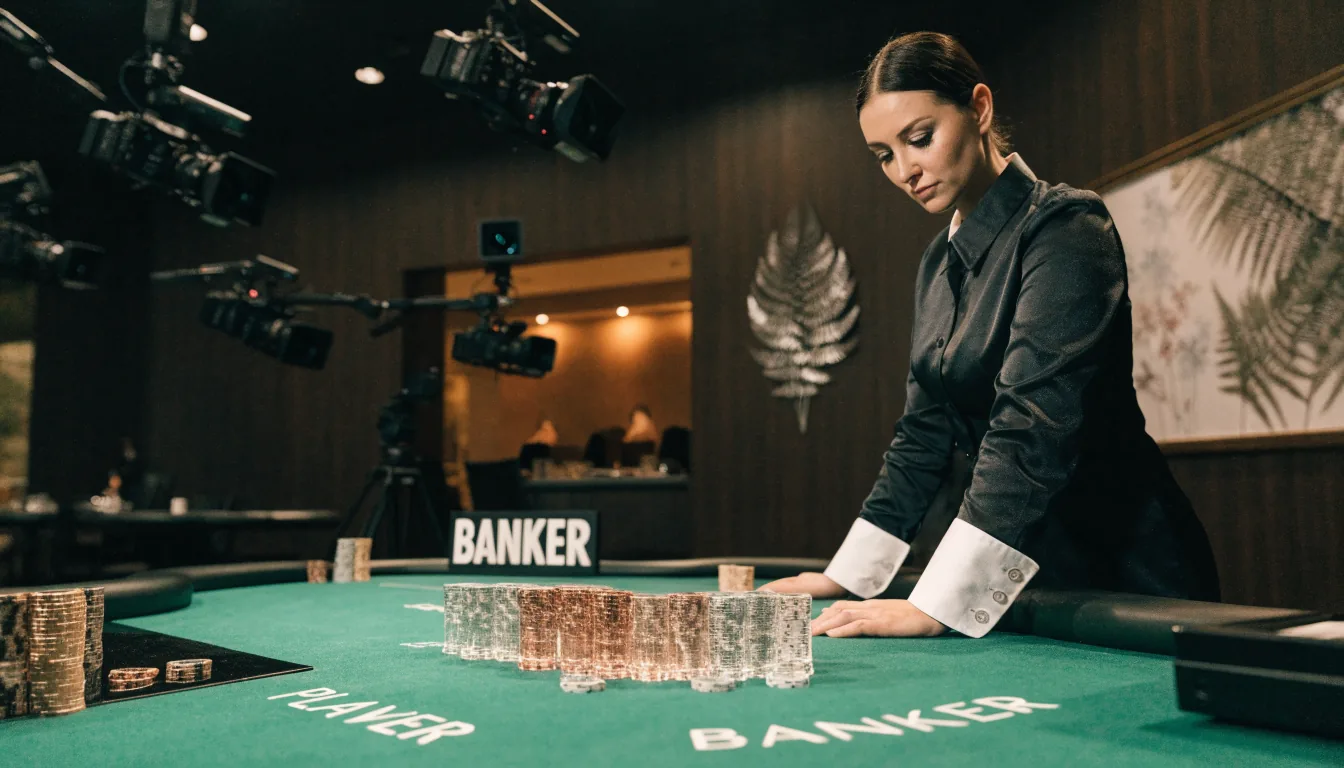
What a Live Baccarat Table Actually Offers
A live baccarat table combines an online game with a physical table setting. The cards are real, and play takes place in a professional studio rather than being presented solely through a software-generated table. You still access the game online, but what you are watching is based on a live table environment, not only on digital graphics.
That distinction is the simplest way to understand what a baccarat live casino offers. In a digital table game, the cards and table are represented on screen by software. In a live version, the table is a real setting and the cards are physical. The screen remains your point of access, but the central visual material comes from an actual game environment.
The difference is not that one format is online and the other is not. Both can be played through an online casino. Rather, they present the game in different ways. A digital version creates its table display through software; a live baccarat game uses real cards and a professional studio. If you are comparing online table games, that is a more useful distinction than treating “live” as simply another label for baccarat.
Choosing a live baccarat site in New Zealand means weighing the details available about each operator before you play. Use these short verdicts as a starting point for your 2026 shortlist.
-
Neospin
- License
- Tobique Gaming Commission, licence no. 0000064
Neospin lists a Tobique Gaming Commission licence, number 0000064. You can use that licensing detail as one point of reference.
-
BitStarz
- License
- Curaçao Gaming Authority, licence no. OGL/2024/165/0185
BitStarz lists a Curaçao Gaming Authority licence, number OGL/2024/165/0185. You can consider this stated credential when reviewing the operator.
-
Ricky Casino
- License
- Tobique Gaming Commission, licence no. 0000002
Ricky Casino lists a Tobique Gaming Commission licence, number 0000002. You can use the licence information as a reference when assessing it.
-
Zotabet
- License
- 07017519840
- Payout speed
- 1-3 business days
Zotabet lists licence identifier 07017519840 and a payout speed of 1–3 business days. You can consider both details when reviewing the operator.
-
7Bit Casino
- License
- Tobique Gaming Commission, licence no. 0000091
7Bit Casino lists a Tobique Gaming Commission licence, number 0000091. You can take this stated licensing detail into account.
-
Wintino
- Payout speed
- 1-3 business days
Wintino lists a payout speed of 1–3 business days. You can use that information as a practical point of reference.
-
Lamabet
- Payout speed
- 1-3 business days
Lamabet lists a payout speed of 1–3 business days. You can consider this detail when reviewing the operator.
-
Play Grand
- License
- Malta Gaming Authority, licence no. MGA/B2C/370/2017
Play Grand lists a Malta Gaming Authority licence, number MGA/B2C/370/2017. You can use this licensing information as one reference point.
-
N1 Casino
- License
- Malta Gaming Authority, licence no. MGA/B2C/394/2017
N1 Casino lists a Malta Gaming Authority licence, number MGA/B2C/394/2017. You can take this stated credential into account.
A professional studio also gives the game a defined physical setting. The table is not just a graphic surface on a screen: it is part of a real studio environment designed for live dealer games. That does not change baccarat into a different game, but it does change what you see while playing. The experience is organised around a physical table rather than a wholly simulated one.
For someone looking for live baccarat online, the format can therefore feel closer to watching a casino table than to using a conventional digital game. The real cards make the difference visible. You are not looking at a software-created image of cards as the entire basis of the game; you are seeing cards used at a real table. The presentation remains digital in the sense that you view it on a screen, but the table activity itself is physical.
It is worth keeping that distinction in proportion. “Live” does not mean that you are physically present in the studio, and it does not make the online game identical to sitting at a table in person. You are still using an online service and receiving the game through a screen. The real-card setting changes the source of what is shown, not the fact that you are playing remotely.
The term “live dealer” describes this broader format across casino games: real equipment and a professional studio form the setting, while the player joins online. In baccarat, the relevant equipment is the physical cards. Other live dealer games may use other real items, such as wheels, but baccarat’s table is defined by its cards. That is why a live casino baccarat game should not be confused with a digital baccarat table merely because both appear on a screen.

This can matter if you prefer a game to have a visible physical setting. A software-generated table may be clear and direct, but it is still a digital representation. A live table places the cards within a professional studio context. Some players will find that setting more engaging; others may be content with a purely digital display. The format itself does not establish which one is better for you.
When comparing a live baccarat online casino with a site’s digital table games, focus on what the label describes. In a live game, real cards and a professional studio distinguish the table from a game built entirely around software-generated visuals. The rest of the online experience still depends on the particular service and its presentation, so the word “live” alone should not be taken as a promise about every feature.
For Kiwi players, “live baccarat” usually means this combination of a physical table setting and online access. You do not need to treat it as a separate version of baccarat simply because the cards are real. It is the format of presentation that differs: the game is hosted in a studio, while you follow it remotely. The basic appeal is straightforward—an online baccarat table with real cards, rather than a purely simulated display.
The Dealer, the Video Feed and the Live Table
In a live baccarat game, the dealer reaches your screen through a video feed rather than appearing as an animation generated entirely by the game software. The broadcast comes from a studio or a casino based in a particular country, where a professional dealer conducts the game in real time. You watch that person and the physical table while using the casino’s interface to take part.
That combination can make the experience feel different from a digital table game. The cards and the dealer are present in the broadcast, while the screen also carries the information and controls you need to follow the game. The dealer is not a character responding to a pre-recorded sequence: the game is being conducted live, and the video lets you see the person carrying it out.

The stream is the link between the physical table and your device. It shows the dealer as the game proceeds, while the online interface presents the parts of play that require your attention. The exact screen layout depends on the game and the casino, so it is sensible to look at how a particular table is presented before joining. A clear image matters, but so does being able to understand what is happening without confusing the video with the game controls.
Interaction is part of the format. You are playing against a real dealer in a live broadcast, rather than simply watching a clip of someone dealing cards. The game is designed to let online players interact with professional dealers as the action unfolds. That does not mean every table offers identical ways to communicate or that the dealer can respond to every individual request. The available interaction depends on the specific game interface.
For you, the practical distinction is that the video conveys the live action, while the casino’s software connects your choices to the game. Those two elements have to work together. If the stream is visible but the interface is not responding, you may not be able to participate as intended; if the interface is active but the video has stopped updating, it may be difficult to tell what is happening at the table. The screen is not just decoration around a digital game: it is how you observe a physical game being broadcast and take part remotely.

A live feed also means the experience depends on a functioning connection between the broadcast and your device. A specialist review reports that technical problems can occur in live dealer games. That is a possibility to account for, not a claim that every session will be disrupted or that interruptions follow a predictable pattern. The issue may be noticeable as a break in the picture or a delay in what you see, but there is no single outcome that can be assumed for every casino or table.
If the video appears to pause or behave unexpectedly, avoid guessing what the table has done based only on a frozen image. Check whether the game itself shows an updated status, and use the casino’s available support route if the display remains unclear. The operator’s own information is the place to look for its instructions on interrupted sessions. Different systems may handle a disruption differently, so do not assume that refreshing a page, leaving a table or repeating an action is harmless.
It is also worth separating a brief display problem from the quality of the dealer’s work. A dealer can continue conducting the game in the studio while your device has trouble receiving the feed; conversely, an uninterrupted image does not by itself tell you how the casino handles other technical issues. The screen gives you access to the broadcast, but it is not a complete account of the systems behind it.
Before settling into a table, take a moment to make sure you can see the dealer and follow the interface on the device you are using. If the live image is difficult to view or the controls are hard to distinguish, switching to a more suitable screen may make the experience easier to follow. This is a basic usability check, not a guarantee against interruptions.
The central feature remains straightforward: a professional dealer conducts a physical game, and a live video feed brings that table to you. The broadcast gives the game a human presence and makes it possible to interact with the dealer in real time. It also means the experience relies on video and technical systems as well as the game itself.
How Baccarat Bets and Outcomes Work
Baccarat asks you to predict which of two hands—the player hand or the banker hand—will finish with the higher value. The names can be misleading: betting on “player” does not mean you are taking a personal hand against the dealer, and “banker” is not a bet on the casino. They identify the two sides in the game. A third possible result is a draw.

Your decision is therefore about the outcome, not about choosing cards or directing either hand. You can back the player, back the banker, or, where offered, select a draw. The live format does not change what those choices mean: the wager concerns which side has the higher hand value, or whether the hands end level.
What the three outcomes mean
A banker win means the banker hand has the higher value; a player win means the player hand is higher. A draw means neither side finishes ahead. These are the possible outcomes against which the main bets are judged.
It helps to separate the result of the hand from the bet you placed. A winning hand does not automatically mean that every wager wins: the wager has to match the outcome it was intended to predict. If you choose banker, for instance, you are backing the banker side to have the higher value. A player bet backs the other side. A draw bet is a prediction that the two sides will finish level.
That distinction is useful when looking at a live baccarat layout, where the labels and betting areas can make the game appear more complicated than the underlying choice. For the two main bets, the question is simply whether the banker or player hand will be higher. The draw is a separate possible result, not another name for either side.
Banker Win
The banker hand finishes with a higher value than the player hand.
Player Win
The player hand finishes with a higher value than the banker hand.
Draw
Neither side finishes ahead, and the hands end level.
The objective is to predict the higher hand, rather than to compete against the dealer. This is different from games in which your own hand is compared directly with the dealer’s. In baccarat, the player and banker labels refer to the two hands being compared, while your role is to select the outcome you think will occur.
Comparing banker and player bets
The banker and player bets are the two central choices, but they do not have identical odds. The house edge for a live dealer baccarat banker bet is around 1.06%, compared with around 1.24% for a player bet. The house edge is a measure of the game’s mathematical advantage for the operator over repeated play; it is not a prediction of what will happen in a particular hand.
The figures are close, but the difference matters when you compare the two bets on the same basis. The banker wager has the lower house edge of the pair, while the player wager has the higher one. That does not mean the banker will win the next hand, or that a player bet cannot win. It describes the relative long-run cost built into each choice, not a reliable way to call an individual result.
Nor does the lower edge turn a banker bet into a safe choice. Each hand still has one of the possible outcomes, and a short run can differ from the long-run mathematical expectation. A streak of results does not alter what the bet means or make a particular side certain to win next. The edge is best read as a comparison between wager types, not as a forecast for a session.

The draw is another outcome to consider, but it is distinct from the two main bets. The figures above apply to banker and player bets; they should not be read as the house edge for a draw wager. Keeping those categories separate avoids treating every marked area on the table as if it carried the same odds.
Reading the choice before you bet
For a straightforward comparison, focus first on the side you are backing and then on the house edge associated with that bet. Banker and player both aim at the same basic question— which hand will be higher—but the stated edge is slightly lower on the banker side. That small numerical difference is a property of the wager, not a promise of better results in any single round.
Baccarat’s central decision is narrow: choose banker, player, or a draw if that option is available. The hand outcome settles which side finished higher or whether the result was level. Understanding those labels and the difference between the two main edges gives you a clearer basis for reading a live baccarat betting layout without mistaking the side names for roles you personally play.
Bitcoin, Other Payments and New Zealand Dollars
Payment choice can affect both the currency you use and how long it takes for money to reach or leave an account. For live baccarat, check the operator’s cashier before making a deposit: payment methods and available currencies can differ between sites, and a method that accepts deposits may not necessarily be offered for withdrawals.
Many operators allow deposits and withdrawals in New Zealand dollars. If you choose an NZD option, the balance can be handled in that currency rather than converted from another one. Check that the currency applies to both directions of payment, not just the deposit screen. Where an account is held in another currency, conversion may affect the amount credited or returned; the precise terms depend on the payment service and operator.
Processing times also vary by method. A specialist review reports crypto payouts clearing in under an hour, POLi and e-wallet payments taking 24 to 48 hours, and bank transfers taking 5 to 7 business days. These are reported timings, not a guarantee for an individual transaction. The operator’s own cashier and withdrawal terms are the relevant place to check what it says about your chosen method, including any verification or processing steps.
Bitcoin is one option at some gambling sites, alongside conventional payment routes. Specialist reviews also identify Neteller and Skrill as methods that can support fast deposits or withdrawals. Availability is not universal, and fast processing does not mean a method is free or free of restrictions: payment services or operators may apply fees or limits. Read the terms for the specific route before sending money, particularly if you expect to withdraw through the same method.
A practical comparison is to consider the currency, the stated withdrawal time and any conditions together. A deposit method may look quick, but the withdrawal route can involve a different timetable. Bank transfers, for instance, are reported in the specialist review as taking longer than the other methods listed above. If you need access to funds by a particular date, do not assume that a deposit’s speed predicts a withdrawal’s speed.

For a live bet on baccarat, the payment itself is separate from the game: choosing Bitcoin or an e-wallet does not change how the table works. It does change how you fund the account and how a later payout may be processed. Before depositing, confirm that the cashier lists your preferred currency and method, then check the stated withdrawal process, fees and any limitations. This is more useful than relying on a general claim that one payment type is fast, because actual availability and timing depend on the operator and the route you select.
Why Free Play May Not Be Available
If you are hoping to try live baccarat without paying, you may find that the free option you expect is not there. Live dealer games are typically not offered for free play. Running a live table carries significant costs for a casino, so providing the game without wagers is not the standard arrangement.
That can be disappointing if you want to get a feel for the experience before spending money. It is also worth separating a live dealer table from a digital game that runs entirely through software: a free version of one does not mean a free version of the other will be available. The live format has operating costs even when a player is not placing a bet.

Do not assume that a site’s general free-play wording applies to its live baccarat tables. It may describe other games or an offer with specific conditions rather than access to a live table at no cost. Check the terms attached to any offer and confirm that live baccarat itself is included before relying on it. If the wording is unclear, treat free access as unconfirmed.
The practical expectation is modest: you may be able to find a live baccarat table, but not a free-play mode for it. A site might offer other ways to play or promotions, but their availability and conditions vary; they should not be mistaken for a guaranteed, cost-free live table. In particular, an offer that requires a deposit is not the same as free access, even if it includes a bonus.
If you cannot find a free live table, that does not necessarily indicate a problem with your device or account. It may simply reflect the cost of operating the service. Look for clear information about whether the game is available without a wager, rather than inferring this from a free-play option elsewhere on the site.
The distinction matters because “free” can describe very different things. A practice mode, a promotional credit and a game that requires a deposit are not interchangeable. Unless the site explicitly confirms that its live baccarat table can be played without a wager, you should not count on being able to test that table for free.
Keeping Pace With a Live Baccarat Round
A live baccarat table runs to a shared schedule, not to each player’s individual pace. You may have only a limited window to place a bet before the game moves on. That short decision period is part of why live games can feel faster than a digital game you control on your own screen.

Some live baccarat games also set time constraints for playing a hand. The exact arrangements can vary between tables, so check the instructions shown in the game before joining. A table’s pace may suit you at one point and feel rushed at another; choosing a game with a rhythm you can follow matters more than trying to keep up with the quickest option.
The betting window is a prompt to make a decision, not an invitation to guess. If you need time to consider what to do, look at the table information before a round begins and be ready when betting opens. Once the window closes, you may have to wait for a later opportunity rather than add or change a bet for that round. A missed window is simply a missed turn; it is not a reason to hurry into the next decision.
This can make live baccarat less flexible than a game where you can pause between turns. You are sharing the timetable with the table, so distractions or a slow connection can matter. If you are interrupted, it may be better to sit out a round than to make a choice before you are ready. The game’s pace does not make any particular bet more likely to succeed.
If the table feels too quick, take a moment before joining to read its displayed rules and timing information. You can also leave rather than continue at a pace that does not work for you. These are practical ways to manage the experience; they do not alter how the game is decided.
Do
- Read displayed rules and timing information before joining.
- Sit out a round if you are interrupted or distracted.
Don't
- Hurry into a decision just because the betting window is closing.
- Assume that one table's timing applies to every other table.
When you play live baccarat online, the central timing question is therefore simple: can you make your decisions within the window the table provides? Some tables allow a constrained period for the hand itself as well as a limited betting period. Since the format differs by game, do not assume that one table’s timing applies to another. A little attention to the on-screen prompts can help you avoid acting under pressure—or finding that the opportunity has already passed.
The Aim of the Baccarat Game
Baccarat is built around a simple comparison: the hand closer to nine is the winning hand. That is the game’s defining aim, whether you are learning the format or following a live baccarat game online. The central question is not which hand has the largest total in an unrestricted sense, but which one is nearest to the target.
That distinction gives baccarat its shape. Nine is the reference point for judging the hands, and the result follows from their distance from it. A hand does not need to reach nine to be closer; the comparison is between the two hands, not against a requirement that either must hit an exact total. If one is nearer to nine, it has the advantage under the game’s objective.
This is useful to keep in mind when you watch a round unfold. The cards and the totals matter because they determine how close each hand is to the target. The game is not about building a sequence, collecting cards for its own sake or trying to beat a dealer’s personal score. Its basic purpose is to identify which of the two hands finishes nearest to nine.

The objective also explains why baccarat can be understood without treating every round as a complicated puzzle. You are following a comparison around a fixed point. Once you know that point, the result has a clear frame: the nearer hand is the one that meets the game’s aim. The details of placing a wager are a separate question; the scoring idea itself is this contest of closeness.
For a new player, it is enough to begin with that principle rather than trying to infer more from the name of a hand or from how a round looks on screen. Baccarat’s defining target is nine, and the outcome turns on which hand is closest to it. Keeping that in view makes the game easier to follow, while leaving the other parts of a round—how you participate and what you choose to predict—to their own explanations.
Using Crypto at a Live Dealer Table
Bitcoin may be available for deposits or withdrawals at some sites offering live dealer baccarat, but its presence should not be assumed. A specialist review describes Bitcoin as a payment method that can support fast transactions, while noting that fees or other limitations may apply. The relevant terms depend on the operator and the payment route it accepts.
The same review reports that crypto payouts can clear in under an hour. Treat that as a reported possibility, not a promise: processing times can vary, and a site’s own withdrawal rules still matter. Before sending funds, check whether Bitcoin is accepted for both deposits and cash-outs, whether the account must be verified, and whether the operator deducts a fee or sets conditions for withdrawing crypto.
- Confirm Bitcoin is accepted for both deposits and cash-outs.
- Check for any operator fees or withdrawal conditions.
- Verify the wallet address and network match the operator's instructions.
- Determine which currency is used for the account balance and conversion.
The speed of a payout is only one part of the decision. You also need to consider the value of the crypto when it is converted or received; a transfer arriving quickly does not fix a change in its market value. Confirm which currency the site uses to show your balance and how it calculates any conversion.
If you choose Bitcoin, make sure the wallet address and network match the instructions provided by the operator. Transfers sent to the wrong address or through an unsupported network may not be recoverable. Keep a record of the transaction and check the status in your account if the funds do not appear as expected.
Crypto can be an option for funding a live baccarat account, but the practical details are operator-specific. Read the payment and withdrawal terms before making a deposit, rather than relying on a general claim about speed.
Checking Whether a Live Baccarat Site Is Regulated
Before using live baccarat sites, check who is responsible for overseeing the operator. An offshore site may be accessible to Kiwi players, but access alone does not show that it is regulated or establish what protections apply. Look for oversight by a recognised gambling body and identify which operator the stated regulatory status belongs to.
Treat a licence claim as something to verify, not as proof in itself. Check the operator’s licence status with New Zealand’s Department of Internal Affairs (DIA). The name on the site should match the operator whose status you are checking; a game provider or a brand name may not be the legal operator.

It is also worth separating two questions: whether an operator is regulated by a recognised gambling body, and whether its licence status is confirmed by the DIA. A statement on a site may address the first without settling the second. If you cannot establish who operates the service or verify its status, do not assume that a prominent badge or claim answers those questions.
These checks do not guarantee that a particular game will run without problems or resolve a dispute in your favour. They help you understand who oversees the operator before you decide whether to play. For an offshore service, that distinction matters: a polished live table is not a substitute for knowing which body, if any, regulates the business behind it.
The 2026 Licensing Changes and What They Mean for Players
The Online Casino Gambling Act 2026 began taking effect on 1 May 2026, creating New Zealand’s first domestic licensing system for online casino gambling. Live dealer tables fall within the same licensing category as online slots and digital table games; they are not treated as a separate kind of licence.
The framework permits a maximum of 15 licences across the online casino sector. A transition period runs until 1 December 2026. Online casinos that were already serving people in New Zealand before the Act took effect may continue during that period, subject to its transitional rules. From 1 December, operators without a licence application must stop serving Kiwi players. Under the new regulations, only the 15 approved operators will be legally permitted to accept players in New Zealand.
That does not mean New Zealand has a Kiwi-specific licence available to offshore sites. The new system is a domestic framework for online casino operators, including those offering live baccarat. Its implementation is staged, with the fully licensed regime not expected to be operational until 2027.

For players, the dates mark a change in which operators may legally provide online casino services, not a change to how a baccarat hand is played. The licensing framework is also separate from checking an individual site’s regulatory standing: a general account of the new rules cannot confirm whether a particular operator is approved or properly regulated. During the transition, access to an offshore site and its status under the new system are distinct matters.
Can New Zealand players play real-money live dealer games at offshore casino sites?
Yes. New Zealand players can access live dealer games at offshore gambling sites, but should check that the operator is regulated by a recognised gambling body and confirm its licence status with the Department of Internal Affairs.
Which live dealer games can New Zealand players usually access?
You can find live baccarat, blackjack and roulette. These games use real cards or wheels and are broadcast from a professional studio.
What is the best live casino game to win money?
Live baccarat has a relatively low house edge: around 1.06% on banker bets and 1.24% on player bets. Those figures describe the house edge, not a guarantee that you will win.
How fast do live casino withdrawals arrive?
Crypto payouts often clear in under an hour; POLi and e-wallet withdrawals take 24 to 48 hours, while bank transfers take 5 to 7 business days.
How many operators can hold a licence?
The Online Casino Gambling Act 2026 allows up to 15 licences for the online casino sector, including live dealer tables. From 1 December 2026, only 15 approved operators will be legally permitted to accept New Zealand players.
Casinos in New Zealand: Online Options and Guides
Content created by the «casinoslotguidenz.com» team